
High-Power Portable Audio Systems for Wholesale & OEM
Direct OEM/ODM catalog selections featuring high-efficiency Class-D amplifiers, long-life lithium power units, and IPX-rated enclosures.
Executive Summary: Global High-Power Boombox Sourcing Landscape
The global portable audio market has underwent a seismic structural shift. Driven by demand for outdoor lifestyle gear, event PA systems, and jobsite durability, the high-power boombox category (defined as battery-powered acoustic enclosures delivering over 60W Continuous RMS power) has registered a 14.8% CAGR over the past three fiscal years. B2B buyers, brand owners, and procurement managers navigating this sector face a complex landscape characterized by rapid technological iteration in Class-D digital amplifiers, lithium-ion energy density shifts, and evolving consumer sound preferences.
Selecting the right OEM/ODM manufacturing partner requires looking beyond surface-level specifications such as advertised peak wattage. True acoustic performance relies on low total harmonic distortion (THD), sustained RMS power delivery under low voltage conditions, thermal dissipation efficiency inside sealed enclosures, and long-term acoustic transducer compliance. This whitepaper analyzes manufacturing benchmarks, acoustic technology, power topology, and supply chain verification standards for global audio procurement professionals.
Procurement Metric Alert: Advertised "Peak PMPO Wattage" is often inflated by non-certified manufacturers by up to 10x over true continuous output. Standardize your RFQ documentation on RMS (Root Mean Square) output measured at <1% THD across a 20Hz–20kHz spectrum.
Technical Architecture of Modern High-Output Audio Systems
High-output portable boomboxes require a multi-disciplinary balance between electrical power management, digital signal processing (DSP), dynamic driver engineering, and mechanical structural integrity. Modern tier-1 factories utilize specific component architectures to achieve deep bass without sacrificing vocal clarity.
DSP Algorithm Tuning
Proprietary dynamic EQ algorithms (such as Tribit XBass®) dynamically calculate transducer excursion limiters in real-time, boosting sub-bass frequencies at lower SPL while preventing voice-coil bottoming at high volumes.
Smart Power Rail Buck-Boost
Advanced power management ICs maintain stable voltage supply to Class-D amplifiers even as battery level drops below 30%, eliminating dynamic compression and audio brownouts.
Hermetic Enclosure Engineering
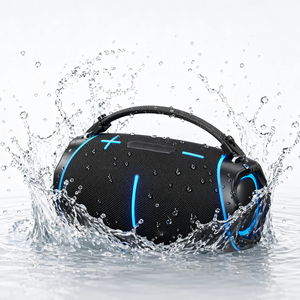
Acoustically sealed internal chambers with high-density ABS/PC injection molding prevent cabinet panel resonance and sustain IPX6/IPX7 waterproof immersion integrity under extreme hydrostatic pressure.
Subwoofer Driver Architecture & Passive Radiator Alignment
High-power boomboxes rely on long-throw neodymium or heavy-ferrite subwoofers combined with dual passive radiators. In sealed acoustic enclosures under 15 liters of internal volume, passive radiators replace traditional ported bass-reflex tubes to eliminate wind turbulence noise ("chuffing") while extending low-frequency response down to 40Hz. Tier-1 manufacturers implement dual-opposing radiator arrangements to cancel mechanical cabinet vibration, allowing the unit to remain stationary on smooth surfaces during maximum sound output.
Key Sourcing & Procurement Trends (2025–2030)
When selecting a manufacturing partner for long-term production, procurement teams must evaluate the vendor's roadmap across several critical technology vectors:
- 1. Bluetooth 5.4 & Auracast Broadcast Audio: Legacy TWS (True Wireless Stereo) pairing limited linkability to two devices. Next-generation boomboxes incorporate Bluetooth 5.4 with LE Audio and Auracast support, allowing a single host source to broadcast low-latency synchronized audio to hundreds of speakers simultaneously across large event venues.
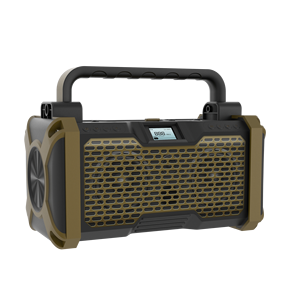
- 2. LiFePO4 Battery Integration: While standard NCM (Nickel Cobalt Manganese) 18650/21700 cells offer high initial energy density, leading suppliers are transitioning to LiFePO4 (Lithium Iron Phosphate) chemistry for heavy-duty jobsite and marine boomboxes. LiFePO4 delivers 3,000+ charge cycles (versus 500 cycles for NCM) and superior thermal stability under direct sunlight exposure.
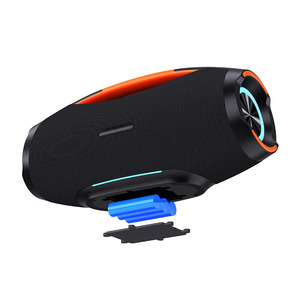
- 3. Modular & Field-Replaceable Power Packs: EU eco-design directives and right-to-repair mandates are pushing commercial boombox designs toward toolless, hot-swappable battery bays. This allows rental operations and construction crews to swap depleted battery modules without discarding acoustic chassis components.
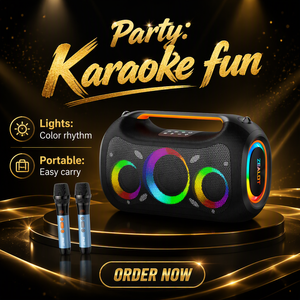
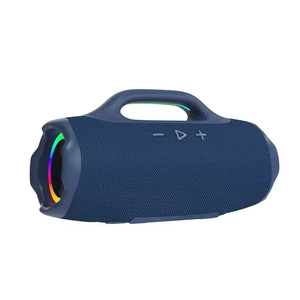
- 4. App-Controlled Multi-Band EQ & Firmware Over-The-Air (FOTA): Hardware capabilities are increasingly unlocked via software. Reliable OEM suppliers provide customizable iOS/Android software development kits (SDKs) to enable custom branding, user-definable 9-band graphic EQs, ambient light syncing, and cloud-based FOTA performance updates.
Evaluating Manufacturer Quality Control & Certification Rigor
Acoustic manufacturing involves stringent quality assurance protocols to eliminate unit-to-unit frequency response variance and field returns. When conducting supplier audits in major manufacturing hubs (such as Shenzhen, Dongguan, and Huizhou), procurement teams should inspect the following factory verification milestones:
1. Anechoic Chamber Testing: Verify that the supplier operates an in-house calibrated semi-anechoic acoustic chamber equipped with Audio Precision (APx555 or similar) sound analyzers. Frequency response curves must meet strict tolerance masks (+/- 3dB across operating range).
2. Ingress Protection (IP Code) Validation: Waterproof certification requires rigorous testing apparatus. IPX6 testing mandates high-pressure water jets (100 liters/min at 100 kPa from 3 meters), while IPX7 requires complete submersion in 1 meter of water for 30 minutes. Ensure test certificates are issued by accredited third-party labs (SGS, TUV, Intertek).
3. Battery Safety & Global Compliance: High-capacity lithium battery packs transported internationally must carry valid UN38.3 transport safety reports, MSDS documentation, IEC 62133 safety compliance, and regional certifications including CE, FCC, RoHS, REACH, and PSE.
B2B Audio Sourcing & OEM Manufacturing FAQ
What is the typical Minimum Order Quantity (MOQ) for custom OEM high-power boomboxes?
How do manufacturers calculate and verify battery runtime specs for 80W+ boomboxes?
What is the difference between peak wattage, RMS wattage, and PMPO in product specifications?
What thermal management steps are needed for sealed IPX7 high-power speakers?
Can customized RGB lighting effects impact overall audio performance or battery longevity?
What compliance testing is mandatory for distributing audio boomboxes in European and North American retail markets?
Enterprise Advantage: Advanced Acoustic R&D & Global Supply Capacity
As a global consumer audio pioneer, our engineering philosophy blends nature-inspired design with acoustic physics. Powered by proprietary algorithms including XBass® for deep low-frequency dynamic expansion and RunStretch® for adaptive dynamic power rail management, our speaker systems deliver stable output across extended listening sessions.
Our manufacturing footprint features end-to-end operational capabilities, including high-precision SMT surface mount lines, automated voice-coil alignment fixtures, eco-friendly acoustic spray booths, and automated 100% inline Audio Precision acoustic testing. By maintaining direct strategic relationships with chipset vendors (Qualcomm, Actions, BES) and battery cell vendors, we offer global partners dependable lead times, stable BOM costs, and comprehensive after-sales warranty coverage in North America, Europe, and Asia-Pacific.